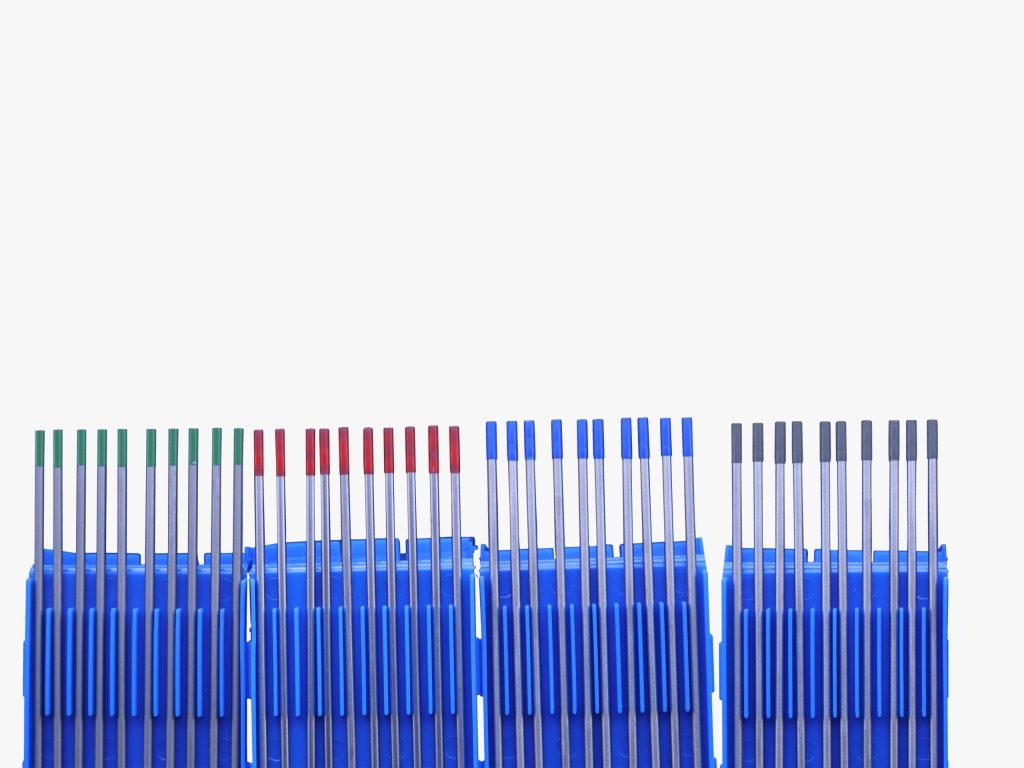
TYPES OF TUNGSTEN ELECTRODES
1. Pure Tungsten (WP, Green):*
2. Thoriated Tungsten (WT20, Red):*
3. Ceriated Tungsten (WC20, Orange):*
4. Lanthanated Tungsten (WL20, Blue):*
5. Zirconiated Tungsten (WZ3, Brown/WZ8, White):*
| Designation | Chemical Composition — Impurities ≤ 0.2% | Tip Color | ||
|---|---|---|---|---|
| ISO 6848 | AWS A5.12 | Oxide Additive, % | Tungsten, % | |
| WT20 | EWTh-2 | ThO₂: 1.70-2.20 | Balance | Red |
| WP | EWP | — | Balance | Green |
| WL15 | EWLa-1.5 | La₂O₃: 1.30-1.70 | Balance | Gold |
| WC20 | EWCe-2 | CeO₂: 1.80-2.20 | Balance | Gray |
| WL10 | EWLa-1 | La₂O₃: 0.80-1.20 | Balance | Black |
| WL20 | EWLa-2 | La₂O₃: 1.80-2.20 | Balance | Sky-blue |
| WZ3 | EWZr-1 | ZrO₂: 0.15-0.50 | Balance | Brown |
| EWG | La₂O₃, CeO₂ & Y₂O₃ : 1.80-2.20 | Balance | Aqua | |
Signal Word Warning
Precautionary Statements Prevention
Response
Storage:
Store in a closed container in a secure and dry location.
For thoriated tungsten electrodes, store in tightly closed containers in a cool and well-ven-tilated area. Nobody should remain permanently or longer than necessary in close proxim-ity to the stored thoriated tungsten electrodes as they may emit beta and gamma radia-tion. Additional measures should be taken to protect from such possible beta and gamma radiation. Thoriated tungsten electrodes may be incompatible with some strong acids.
Disposal
Dispose of contents/container in accordance with local/regional/national/international regulations.
FIRST AID MEASURES
No first aid measures should be required for the unused electrodes. The following first aids should be exercised during welding operations:
FIRE FIGHTING MEASURES
The electrodes do not present fire or explosion hazards as shipped. However, welding arc and sparks can ignite combustibles. See Z-49.1 referenced in Section VIII. Welding should not be carried out in the presence of flammable materials, vapors, tanks, cisterns and pipes and other containers which have held flammable substances unless these have been checked and certified safe.
ACCIDENTAL RELEASE MEASURES
No specific actions for electrodes prior to use. Welding in proximity to stored or used halogenated solvents may produce toxic and irritant gases. Prohibit welding in areas where these solvents are used.
HANDLING AND STORAGE
Work Practices and Hygiene Practices: After the end of work shift, hands and other exposed skin should be thoroughly washed. Do not eat or drink during use of these products. Use ventilation and other engineering controls to minimize potential exposure to fumes during welding operations or to dusts if tips of electrodes are ground. Follow good house-keeping practices to ensure powders or dusts from grinding operations do not accumulate, which can be highly flammable and can pose special health hazards if from thorium-containing electrodes.
Tungsten-Thorium Oxide alloys are generally safe to handle during use under almost all normal conditions and environments. However, special precautions must be taken during the grinding or machining of tips of electrodes that contain Thorium Oxide to avoid the generation and subse- quent inhalation and ingestion of dusts from these operations. Any dusts generated during these operations may be considered as “Source Material”, as defined by the Nuclear Regulatory Commission, and therefore be subject to the requirements of 10 CFR, Parts 20 and 40. Routine wet mopping or vacuuming with an explosion-proof vacuum, fitted with a HEPA filter, may be considered to reduce accumulation of dusts.
Storage and Handling Practices: All employees who handle these materials should be trained to handle it safely. Avoid breathing dusts or powders generated during grinding of electrode tips. Open packages and containers of these products slowly, on a stable surface. Packages and containers of these products must be properly labeled.
PHYSICAL AND CHEMICAL PROPERTIES
STABILITY AND REACTIVITY
There is no stability or reactivity hazards from welding electrodes as supplied. Hazardous decompo-sition products such as metal oxide fumes and gases (see Section VIII) are produced during grinding and welding. Welding fumes and gases cannot be classified simply. The composition and quantity of these fumes and gases are dependent on the metal being welded, the procedures followed and the electrodes used.
Workers should be aware that the composition and quantity of fumes and gases to which they may be exposed are influenced by: coatings which may be present on the metal being welded (such as paint, plating, or galvanizing), the number of welders in operation and the volume of the work area, the quality and amount of ventilation, the position of the welder’s head with respect to the fume plume, as well as the presence of contaminants in the atmosphere (such as chlorinated hydrocarbon vapors from cleaning and degreasing procedure). When the electrode is consumed, the fumes and gas decomposition products generated are different in percentage and form from the ingredients listed in Section II. The composition of these fumes and gases are the concerning matter, not the composition of the electrode itself.
Decomposition products include those originating from the volatilization, reaction, or oxidation of the ingredients shown in Section II, as well as those from the base metal, coating and the other factors noted above.
Gaseous reaction products may include carbon monoxide and carbon dioxide.
Ozone and nitrogen oxides may be formed by the radiation from the arc.
One method of determining the composition and quantity of the fumes and gases to which the workers are exposed is to take an air sample from inside the welder’s helmet while worn or within the worker’s breathing zone. See ANSI/AWS F1.1 publication available from the American Welding Society 550 N.W. LeJeune Road, Miami, Florida 33126.
TOXICOLOGICAL INFORMATION
Welding fumes, if inhaled, can potentially produce several different health effects caused by the metal containing particles and the gases produced during the welding process, both of which are present in the ‘fumes’. The exact nature of any likely health effect is dependent on the consumable, material being welded and welding process, all of which affect fume quantity and composition, as well as the use of adequate ventilation, respirators, or breathing equipment as circumstances require.
Inhalation of the fumes/gases produced during welding may lead to irritation to the nose, throat and eyes. The range of health effects include respiratory effects with symptoms such as asthma, impaired respiratory and lung function, chronic bronchitis, metal fume fever, pneumoconiosis, possible emphysema and acute pulmonary oedema.
Other potential health effects at elevated levels of exposure include central nervous effects possible lung cancer, bone disease, skin and fertility effects. Which of these health effects is potentially likely is related to the fume composition, and this needs to be consulted with the specific toxicity data below to assess the health risk when using any particular welding process.
Unprotected skin exposed to UV and IR radiation from the welding arc may burn or redden, and UV radiation is potentially a carcinogen. UV radiation can affect the unprotected eye by producing an acute condition known as ‘arc eye’.
Specific effects relevant to major particulate and gaseous fume constituents may be produced from these electrodes, (excluding fume from filler material and the components being welded).
Tungsten: Any fume or dust given off by these electrodes will consist mainly of tungsten and tungsten oxides. Exposure to tungsten and its compounds as a dust or fume generally shows low toxic-ity with no long term fibrotic effects on the lung. Some lung effects observed with exposure to tungsten carbide dust have been attributed more to cobalt than to tungsten compounds.
Thorium: Thoriated electrodes contain Thorium, which is radioactive. The exact amount of thorium in the fume depends on the grade of thoriated electrode used as well as the welding parameters. Under DC supply, fume levels from the tungsten electrode during welding are negligible, and hence any exposure to radioactivity is also negligible. However, during electrode grinding and AC welding, fume or dust containing thorium will be emitted and exposure to radioactivity will be higher. Under these circumstances, extract ventilation is required to control any fume/dust emissions. Thorium is a radioactive substance that emits beta radiation externally and alpha radiation internally. The latter radioactive properties can cause cancer of specific organs.
Cerium: Cerium is relatively non-toxic to humans and no adverse health effects would be expected from exposure to cerium dust or fume.
Lanthanum: Lanthanum is relatively non-toxic to humans and no adverse health effects would be expected from exposure to lanthanum dust or fume.
Zirconium: Zirconium is relatively non-toxic to humans and no adverse health effects would be expected from exposure to zirconium dust or fume.
Ozone and Nitrogen oxides: These gases are formed due to interactions of the arc with the surrounding air. Both gases can produce eye, respiratory and lung irritation and also can produce longer term lung effects such as decreased lung capacity, chronic bronchitis, and emphysema. Of particular concern with both gases is that exposure to high levels (eg due to build up in confined spaces) can result in acute lung effects such as delayed pulmonary oedema
ECOLOGICAL INFORMATION
The welding process produces particulate fumes and gases which may cause long term adverse effects on the environment if released directly into the atmosphere. Welding some materials with the electrodes covered by this data sheet can produce carbon dioxide gas, which is dangerous to the ozone layer.
DISPOSAL CONSIDERATIONS
Packaging and electrode stubs should be disposed of as general waste or recycled.
No special precautions are required for this product, except for the grinding dust and stubs of thoriated electrodes, which may require special disposal, especially if in large quantities.
TRANSPORT INFORMATION
The majority of the time, thoriated tungsten electrodes are properly shipped per limited quantity exceptions as described at 49 CFR 173.421. However, large quantity shipments may be fully regulated as Class 7 radioactive materials.
OTHER INFORMATION
The customer should provide this Safety Data Sheet to any person involved in the materials use or further distribution. Miller Electric requests the users (or distributors) of this product to read this Safety Data Sheet carefully before usage.
The information contained in this Safety Data Sheet relates only to the specific materials des-ignated and may not be valid for such material used in combination with any other material or in any other process.
Miller Electric believes that the information contained in this (SDS) Safety Data Sheet is accu-rate. However, Miller Electric does not express or imply any warranty with respect to this infor-mation.
The product is supplied on the condition that the user accepts the responsibility to satisfy himself as to the suitability and completeness of such information for his own particular use. Freedom from patent rights must not be assumed.
APPLICATIONS
Precision Welding:
Aerospace Industry:*
Automotive Industry:*
Maintenance and Repair:*